
Abstract
Mandibular premolars have earned the reputation for having aberrant anatomy. The occurrence of three canals with three separate (type V, Vertucci) foramina in mandibular premolars is very rare. If one is to treat mandibular premolar teeth with three canals predictably, it is necessary to be aware of their clinical and radiographic anatomy. These teeth may also require special shaping and obturating techniques. This article reports and discusses the treatment recommendations for an unusual occurrence of three canals with three separate foramina in both the first and second mandibular premolars in the same patient.
Consistent, high levels of success in endodontic treatment require an understanding of root canal anatomy and morphology. To achieve endodontic success, the entire root canal system must be debrided, disinfected and obturated. The clinician must have a thorough understanding of normal anatomy, and of common variations from the norm. The clinician must also be prepared to identify those teeth that tend to vary greatly from the norm, e.g. mandibular premolars.
Quite a few studies were published in endodontic literature that studied the common reasons for endodontic failures (1–3). Hoen and Pink found a 42% incidence of missed roots or canals in the teeth that needed retreatment in their investigations (4). They concluded that the clinical application of a thorough knowledge of canal anatomy and meticulous attention to treatment detail are essential to minimizing failure and the need for subsequent endodontic retreatment.
In a series of studies on extracted teeth Vertucci in the 1970s and 1980s determined canal numbers and configurations by percentages for each of the teeth (5). Vertucci’s data may not be exactly representative of different locations and ethnic groups, but it is a good starting point for understanding root canal anatomy.
Mandibular premolars have gained a reputation for having aberrant anatomy. Different studies have looked at the root canal morphology of mandibular premolars over the years and reported a fairly high percentage of these teeth to have more than one canal (6–9).
There seems to be a racial predisposition for the presence of two or more canals in maxillary and mandibular premolars (10, 11), as well as their bilateral occurrence (12). The occurrence of three canals with three separate (type V, Vertucci) foramina in mandibular premolars is very rare. Vertucci and Zillich et al. reported the occurrence of three canals in mandibular first premolars at 0.5% and 0.4% respectively. Their studies in second premolars showed these percentages at 0.0% and 0.4%, respectively (13, 14).
If one is to treat mandibular premolar teeth with three canals, predictably, it is necessary to be aware of their clinical and radiographic anatomy. These teeth may also require special shaping and obturating techniques.
The purpose of this article is to report, as well as discuss, treatment recommendations for an unusual occurrence of three canals with three separate foramina in both the first and second mandibular premolars in the same patient.
Case Report
A 49 yr-old White Jamaican male with a noncontributory medical history was referred to the author’s private practice for endodontic treatment on the right mandibular first and second premolars by his general dentist.
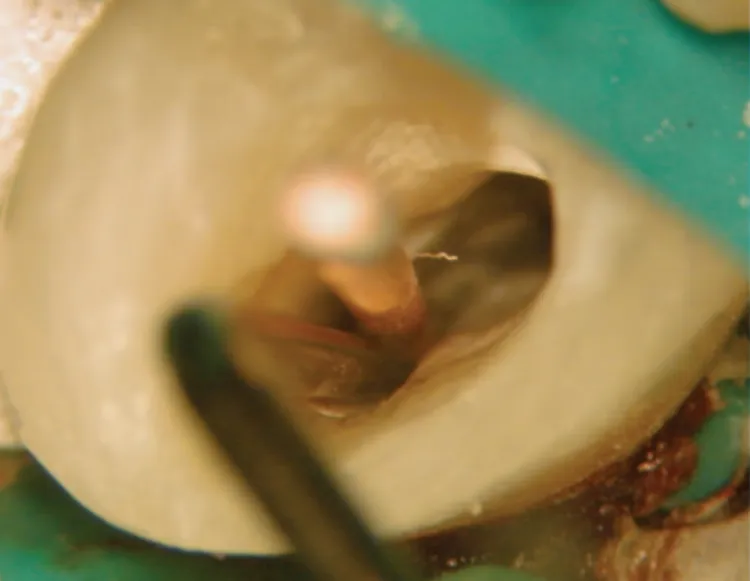
The chief complaint of the patient was “pain in the lower right back teeth.” Clinical examination revealed restorations in the right mandibular first and second premolar teeth (28, 29) with distal caries in 29. Teeth 30 and 31 were missing and 32 drifted mesially. Teeth 28 and 29 tested percussion sensitive. Vitality tests on both teeth showed no response to cold and EPT. Radiographic examination revealed periradicular radiolucencies in relation to 28 and 29. More than one root canal was suspected in both the premolars (Fig. 1A).
A pulpal diagnosis of necrotic pulp and a periradicular diagnosis of acute exacerbation of a chronic periradicular periodontitis were made. Nonsurgical endodontic treatment was planned in both 28 and 29 over two visits with the use of calcium


